 All News
2016: The foundation of an AI ecosystem
Celebrating ten years of Cyber Valley in 2026

In 2016, important actors from science, industry, and politics founded the Cyber Valley Consortium, which became the first Innovation Campus in Baden-Württemberg. Ten years on in 2026, we're revisiting the most important milestones from the last decade. Each month, we'll focus on a particular year since Cyber Valley's beginning.
This month, we're returning to 2016 to look back at Cyber Valley’s foundation. Back then, the AI boom and the wholesale use of LLMs were still some years away. Actors from science, industry, and politics in Baden-Württemberg nevertheless knew that this technology would play an essential role in the state’s future.
Baden-Württemberg was already in an unrivalled position to create AI for the benefit of future society since it is home to several top AI research institutions: the Max Planck Institute for Intelligent Systems, the University of Stuttgart, the University of Tübingen, Fraunhofer-Gesellschaft, and Karlsruhe Institute of Technology (KIT). The next step was to apply their cutting-edge research to solving real-world problems.
This was where Cyber Valley came in. In 2016, the Cyber Valley Consortium was founded with the mission of advocating for the research, development, application, and acceptance of AI and modern robotics. Cyber Valley was to unite excellent research with practical application to build the AI of tomorrow in Baden-Württemberg.
At its founding, Cyber Valley Consortium consisted of the Max Planck Society (which includes the Max Planck Institute for Intelligent Systems, MPI-IS), the state of Baden-Württemberg, and the Universities of Stuttgart and Tübingen, alongside partners from industry: Amazon, BMW, Bosch, IAV, Mercedes-Benz Group, Porsche AG, and ZF Friedrichshafen. Other research institutions joined later, including Fraunhofer-Gesellschaft (in 2019), KIT, and ELLIS Institute Tübingen (both 2024).
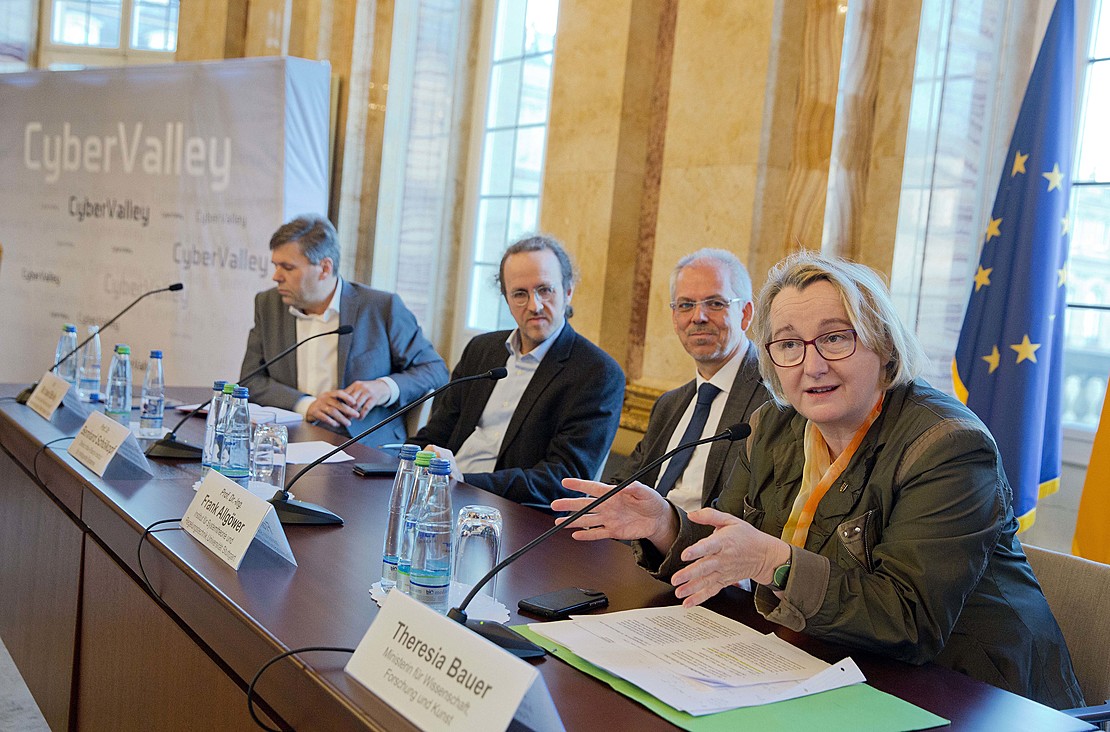
Winfried Kretschmann, Minister-President of Baden-Württemberg, Theresia Bauer, who was then Minister of Science, Research and Art in Baden-Württemberg, and Martin Stratmann, who was then President of the Max Planck Society, launched the consortium on December 15, 2016, in Stuttgart's Neues Schloss along with other participants from the consortium, including Bernhard Schölkopf(MPI-IS), Frank Allgöwer (University of Stuttgart) and Bernd Engler (University of Tübingen). The result was one of the largest research–industry partnerships for AI and modern robotics in Europe.
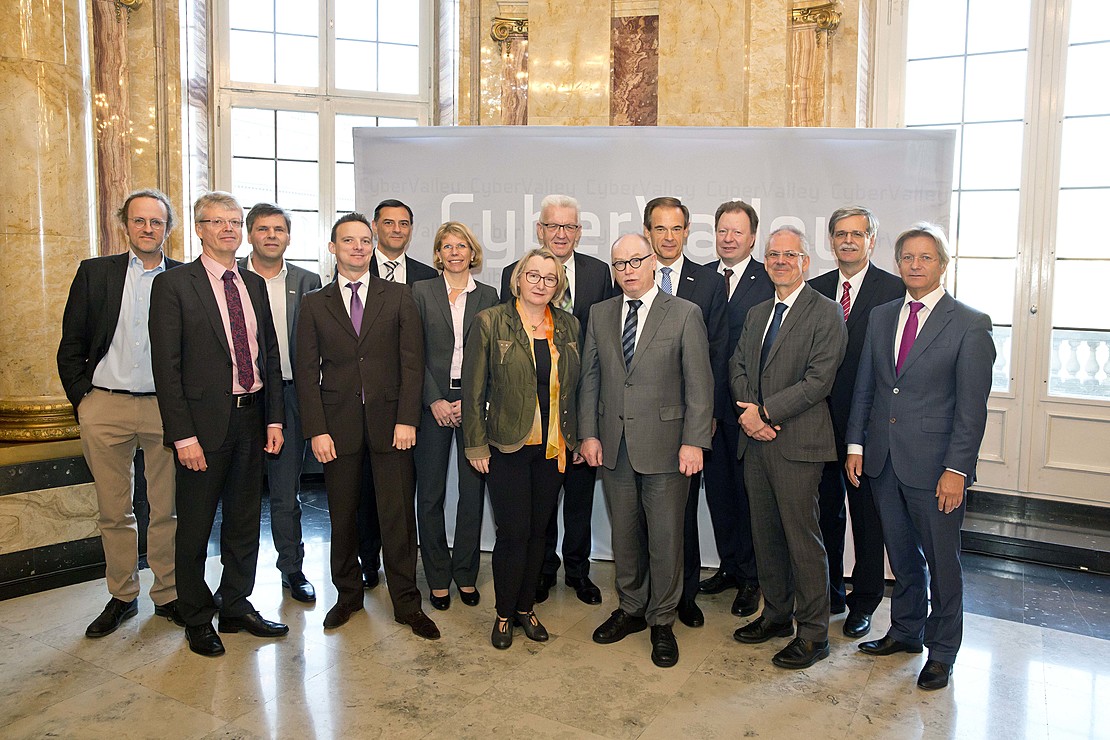
Photo: MPI-IS / U. Regenscheit
Theresia Bauer, Managing Director of the Baden-Württemberg-Stiftung, and Baden-Württemberg’s Minister of Science, Research and Art at the time of Cyber Valley’s founding:
“At the time, I was thrilled by the great opportunity to bundle the excellent research landscape in the fields of AI and computer science in a condensed innovation ecosystem and make it more attractive for top international talent. When Cyber Valley was founded, I hoped that this concentration of cutting-edge research, the promotion of young talent, and responsible innovation would have what it takes to develop great appeal and grow rapidly. Today, you can see that we have succeeded in developing such a positive dynamic, which has a far-reaching impact on science, business, and the entire location.”
Bernhard Schölkopf, Scientific Director of the ELLIS Institute Tübingen and Director of Empirical Inference at MPI-IS:
“We started Cyber Valley with the belief that AI has the potential to change the world, and with the goal to do so in a positive way. This is now commonplace, but launching in 2016 gave us a head start and with a number of exciting start-ups, outstanding research institutions, and initiatives such as ELLIS and MP-AIX, we now have one of the most vibrant AI ecosystems in Europe."
Michael Black, Director of Perceiving Systems at MPI-IS:
“The goal of Cyber Valley has always been to give Germany the chance to build a new high-growth economy around AI. In 2016, AI was not in the headlines, but we believed that we had the raw materials needed to succeed. Through the partnership of government, academia, and industry, we grew the AI faculty, attracted top researchers, built a top graduate program, trained hundreds of AI scientists, attracted investment, and helped launch a network of start-ups. These start-ups were always the goal and they hold the promise of a new Germany economy."
Peter Middendorf, Rector of the University of Stuttgart:
“From the very beginning, the University of Stuttgart pursued the goal of pooling expertise in artificial intelligence and particularly in robotics, within and for the Stuttgart region. Together with the University of Tübingen, the Max Planck Institute for Intelligent Systems, and other partners, we have played a decisive role in shaping and advancing Cyber Valley. This strong network has given rise to excellent research, new professorships, and innovative projects, which we continue to actively drive forward – soon also in the new Cyber Valley building here in Stuttgart.”
Philipp Hennig, Director of Tübingen AI Center, University of Tübingen:
“The world was a different place ten years ago, but even then it was clear that Europe, Germany, and Baden-Württemberg had to increase their efforts to stay relevant for AI. A decade later, I’m glad that we got the political mandate to get started then. The urgency of our tasks has only grown since then; but so have our opportunities.”
Bernhard Beckert, Dean of the KIT Department of Informatics:
“When Cyber Valley was founded in 2016, we saw its potential to increase the visibility of AI research in Baden-Württemberg and to build a regional network that connects talent and accelerates scientific progress. Today, more than ever, this collaborative approach remains essential for supporting responsible AI development and for strengthening the region’s position within an increasingly complex international environment.”
Matthias Tröndle, Head of the Scientific Coordination Office, MPI-IS:
“When we founded Cyber Valley in 2016, we envisioned creating a bold innovation ecosystem focused on artificial intelligence at a time when its transformative impact was not yet widely recognized. By bringing together universities, non-university research institutions, industry, start-ups, foundations, and government in an unprecedented partnership, we broke new ground. The outstanding success of Cyber Valley has since made it a blueprint for subsequent innovation campuses."
To celebrate Cyber Valley's ten-year anniversary, we'll be sharing a variety of content across our website and social media channels reflecting on milestones from the last decade. Stay tuned for the next instalments!


Director of the Perceiving Systems Department at the Max Planck Institute for Intelligent Systems

Chair for the Methods of Machine Learning at the University of Tübingen

Related Articles

2023: Three new AI institutes at Cyber Valley



2022: Hector Foundation supports founding of ELLIS Instit...